


The Kalita Humphreys Theater was built at the request of the Dallas Theater Center. Frank Lloyd Wright was engaged to develop the project. The architect agreed on the condition that one of his ready-made plans would be chosen for the theater, which for various reasons had not yet been implemented. Thus, they chose a ready-made design and adapted it to the city. You can learn more about the theater, which has lost its zest over time, on dallas-trend.
HISTORY OF THE THEATER’S CONSTRUCTION
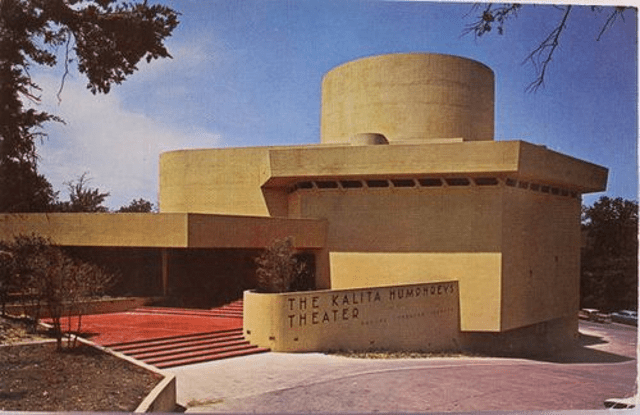
Wright emphasized the combination of architecture with nature, and the theater was built on a limestone cliff that complemented the building, overlooking Turtle Creek. To be more precise, the cliff became part of the theater. Like all of Wright’s projects, the theater’s design was considered bold and innovative for its time. The walls of the building were sand-colored, making it blend in with the surrounding natural landscape. Green groves stretched around it, which over time were gradually replaced by parking lots and ancillary buildings. Construction began in 1955, lasted four years, and cost over $1,000,000.
The theater opened on December 27, 1959, nine months after Wright’s death. The theater was one of the architect’s last completed buildings, and the only professional theater that Lloyd Wright designed personally.
It was named after the American actress Kalita Humphries. The woman tragically died in a plane crash in 1954, and her parents donated $120,000 to create the Dallas Theater Center. Kalita Humphreys collaborated with Paul Baker, the first director of the theater center, so he decided to commemorate her memory by naming the theater in her honor. The auditorium had a capacity of 400 seats. The first performance on the stage of the new theater was Thomas Wolfe’s “Of Time and the River”.
INTERIOR FEATURES OF THE THEATER
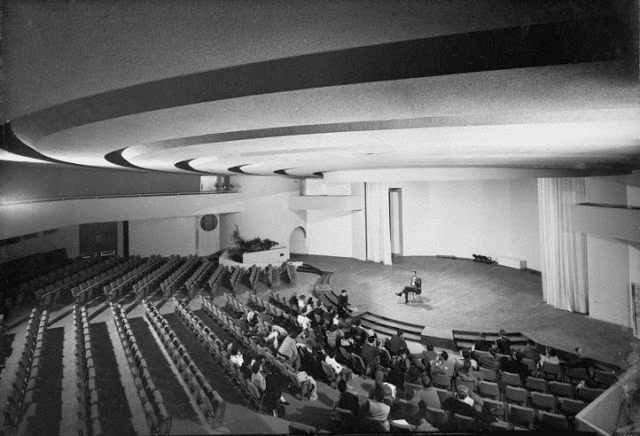
There was a round stage inside the theater, and it was decided not to create a proscenium, so the space between the actors and the audience was minimal, creating a more intimate atmosphere in the hall. Also, when designing the stage, a rotary mechanism was created, which allowed for a quick change of scenery during the performance. There were two ramps leading from the stage to the basement, where the scenery and props were stored. However, it was not very practical to use, as things had to be pulled with great effort. It would have been much more convenient to install an elevator, but the architect would never have agreed to it.
THE THEATER’S DECLINE
In 1973, the theater became the property of the city, which, in turn, leased it to the Dallas Theater Center. Additionally, land plots were purchased around the theater so that they would not be used for high-rise buildings, and the architectural work of art would not be lost behind them. Later, a park named after William B. Dean was created on the free site. Over time, the theater fell into disrepair, as several organizations were responsible for its maintenance. In the following years, reconstruction work was repeatedly carried out with different architects, each of whom had their own vision of the theater’s future appearance. As a result, the building lost almost all the original features laid down by Wright.
In 2009, the Dallas Theater Center moved its administrative offices to the Dee and Charles Wyly Theater, but continued to stage some performances in the Kalita Humphreys Theater. The theater was also used as a performance venue by other local theater companies.
In 2020, the Dallas Theater Center selected Diller Scofidio + Renfro to work on the Kalita Humphreys Theater restoration project.